What's in this guide
How to Confirm You Have Grubs Before Buying Anything
Grub damage looks like many other lawn problems — drought stress, disease, dog spots. Treating for grubs when your problem is something else wastes money and misses the actual issue. Always confirm with a soil test first.
Find a dead or dying patch. Grab the turf at the edge and pull — if the soil is healthy, grass roots will resist. If grubs have been feeding on roots, the turf will roll back like a loose carpet with almost no resistance. Dig 4–6 inches into the exposed soil and count white C-shaped larvae. 5 or more grubs per square foot = treatment threshold. Below 5, the lawn can typically recover on its own.
Grubs are the larval stage of several beetle species — Japanese beetle, European chafer, June beetle, and masked chafer are the most common in North America. All produce white, C-shaped larvae with a brown head capsule, ranging from ½ inch to 1½ inches long depending on species and age. They feed on grass roots from late summer through fall, causing the lawn to die in irregular patches that first appear drought-stressed then go completely brown.
Animals digging holes overnight in your lawn is one of the most reliable secondary signs of a serious grub infestation. These animals are highly effective at detecting grub populations and will tear up turf to reach them. If you're seeing overnight digging damage alongside brown patches, a grub infestation is almost certain — confirm with the turf pull test and treat immediately.
Preventive vs Curative Grub Control — Which Do You Need?
This is the most important decision in grub control — and the most common source of wasted money. Preventive and curative products use different active ingredients that work at completely different stages of the grub life cycle.
| Type | Active Ingredients | Apply When | Control Rate | Works On |
|---|---|---|---|---|
| Preventive | Imidacloprid, Chlorantraniliprole, Thiamethoxam | May–July (before eggs hatch) | 90%+ | Eggs and newly hatched grubs |
| Curative | Trichlorfon (Dylox), Carbaryl | Aug–Sept (on active grubs) | 70–80% | Existing late-summer grubs |
| Preventive applied late | Imidacloprid after July | Wrong timing | 0–20% | Not effective on mature grubs |
Imidacloprid (Grub-Ex, Merit) is the most popular grub product sold — but it only works on eggs and young larvae in June–July. Applied in August or September on mature grubs, it has virtually zero curative effect. If you're seeing active grub damage in late summer, you need trichlorfon (Dylox) — not imidacloprid. This mismatch is the #1 reason homeowners think grub treatments "don't work."
Application Timing Calendar
Grub control timing is stricter than almost any other lawn treatment. A preventive product applied 4 weeks late can drop from 90% to under 20% effectiveness. Use this calendar as your guide.
In Canadian provinces, beetle egg-laying and grub emergence occurs 2–4 weeks later than in the northern USA. Preventive application window: June–August. Curative window: September–early October. In prairie provinces (Manitoba, Saskatchewan, Alberta), the curative window is very tight — treat by mid-September before soil temperatures drop and grubs move too deep for products to reach.
5 Best Grub Killers — Tested & Ranked
Chlorantraniliprole (the active in GrubEx1) is the gold standard for preventive grub control. It works by disrupting muscle function in insect larvae — highly effective on grubs, very low mammalian toxicity, and remains active in the soil for up to 4 months. Applied May–July before eggs hatch, it achieves 90%+ control of Japanese beetle, European chafer, and masked chafer grubs. It has essentially zero curative activity — do not apply after July if grubs are already present. Water in within 24 hours of application to activate.
- 90%+ preventive control rate
- Lowest toxicity of all grub actives
- 4-month residual — lasts all season
- Safe for bees once watered in
- Available at most garden centres
- Zero curative activity — must apply before eggs hatch
- Must be watered in within 24 hours
- Late application = wasted product
- Won't help existing August infestation
Dylox is the only widely available product with genuine curative activity on mature grubs. If you're seeing active grub damage in August or September, Dylox is what you need — not GrubEx or Merit. Trichlorfon is a contact organophosphate that kills grubs within 24–48 hours of soil contact. Apply in August–September when grubs are actively feeding near the surface, water in thoroughly immediately after application (½ inch of water), and keep the lawn moist for 1–2 weeks to keep grubs near the surface where the product is active. Apply when soil temperature is above 60°F — cooler soil means deeper grubs out of reach of the product.
- Best curative activity available
- Fast kill — 24–48 hours
- Effective on existing August infestations
- Can stop active turf damage quickly
- Higher toxicity — keep pets off for 24–48 hrs
- Must water in heavily immediately
- Short residual — not a preventive option
- Less effective on deep or dormant grubs
- Narrow application window
Imidacloprid has been the standard preventive grub control active for decades — available in dozens of products including Grub-Ex (older formulas), Merit, and many generics. It gives 85% preventive control when applied correctly (May–June) and watered in within 24 hours. It's slightly less effective than chlorantraniliprole and has higher bee toxicity during the application window — apply in the evening and water in promptly to reduce pollinator exposure. Stricter timing is required: apply by late June at the latest, as it has minimal activity on 3rd-instar grubs.
- Widely available — most garden centres
- 85% preventive control
- Less expensive than chlorantraniliprole
- 3-month soil residual
- Higher bee toxicity than chlorantraniliprole
- Stricter timing — must apply by late June
- No curative activity on mature grubs
- Some resistance reported in Japanese beetle populations
Milky spore is a naturally occurring soil bacterium that infects and kills Japanese beetle grubs specifically. It's completely non-toxic to mammals, birds, bees, and beneficial insects. The limitation: it takes 2–3 seasons to establish a sufficient soil colony to achieve effective control, and it only works on Japanese beetle grubs — not European chafer, masked chafer, or June beetles. If your grub problem is Japanese beetle and you have time, milky spore is an excellent long-term solution. Not suitable for emergency curative treatment. Also less effective in very cold-winter regions (northern Canada) where spore survival is reduced.
- Zero toxicity — safe for all non-target organisms
- 10+ year residual once established
- Self-propagating — spreads through soil
- No bee risk, no re-entry time
- Approved for all provinces and states
- Takes 2–3 seasons to establish
- Japanese beetle grubs only
- Less effective in very cold climates
- Not a curative treatment
Beneficial nematodes are microscopic roundworms that seek out and parasitize grub larvae in the soil. They're non-toxic, safe for pets and children immediately after application, and available for all provinces including Ontario and Quebec. Control rates of 50–70% are lower than chemical options but meaningful for mild to moderate infestations. Critical requirements: apply in late afternoon or evening (nematodes die in UV light), water the lawn before and after application to keep soil moist, apply when soil temperature is 60–85°F, and use within 24 hours of purchase. Store unused nematodes in the refrigerator.
- Zero toxicity — safe immediately after application
- Works on multiple grub species
- Approved everywhere including ON/QC
- Also targets other soil pests
- No re-entry time for pets or children
- Lower control rate than chemical options
- Very short shelf life — use within 24 hours
- Must apply in evening — sensitive to UV
- Requires consistent soil moisture
- More expensive per treated area
Full Comparison Table
| Product | Active | Type | Control Rate | Apply Window | Toxicity | Canada |
|---|---|---|---|---|---|---|
| Scotts GrubEx1 | Chlorantraniliprole | Preventive | 92% | May–Jul | Very Low | ✓ |
| Dylox 6.2G | Trichlorfon | Curative | 75% | Aug–Sep | Moderate | ✓ |
| BioAdvanced Imidacloprid | Imidacloprid | Preventive | 85% | May–Jun | Moderate | ⚠ Limited |
| Milky Spore | Bacillus popilliae | Biological Prev. | 80%* | Any season | None | ✓ |
| Beneficial Nematodes | Steinernema / H. bacteriophora | Biological Cur. | 60% | Aug–Sep | None | ✓ |
*Milky Spore rate shown after 3-season establishment — year 1 control is 20–30%. Imidacloprid Canada availability varies by province and formulation.
How to Apply Grub Killer — Step by Step
Confirm grubs first — do the turf pull test. Never apply grub killer without confirming the problem. Find a damaged area, peel back the turf, and count grubs. Below 5 per square foot, the lawn will usually recover without treatment. Above 5 per square foot, treat.
Identify which product you need based on timing. May–July = preventive (chlorantraniliprole or imidacloprid). August–September = curative (Dylox/trichlorfon) or biological (nematodes). Do not use a preventive product on an existing infestation — it won't work.
Mow the lawn before applying granular products. Shorter grass allows granules to reach the soil surface more easily. For liquid products, apply to the soil surface directly.
Apply granules evenly with a broadcast spreader. Follow the label rate exactly — over-application doesn't improve results and increases toxicity risk. Set the spreader to the label-specified setting for the product.
Water in immediately and thoroughly. This is critical for all grub products. Apply ½ inch of water within 24 hours of granular application — this activates the product and moves it into the soil where grubs feed. For Dylox, water in the same day. For preventive products, within 24 hours. Without watering in, granular grub products have essentially zero effectiveness.
Keep the soil moist for 1–2 weeks after applying. Especially for curative treatments — moist soil keeps grubs near the surface where the product is active. Dry conditions drive grubs deeper into the soil profile, out of reach of surface-applied products.
Overseed damaged areas 4–6 weeks after treatment. Once grub activity is controlled, bare and thin areas left by grub feeding need to be reseeded. See our overseeding guide for timing and technique. Apply a light starter fertilizer to support new grass establishment.
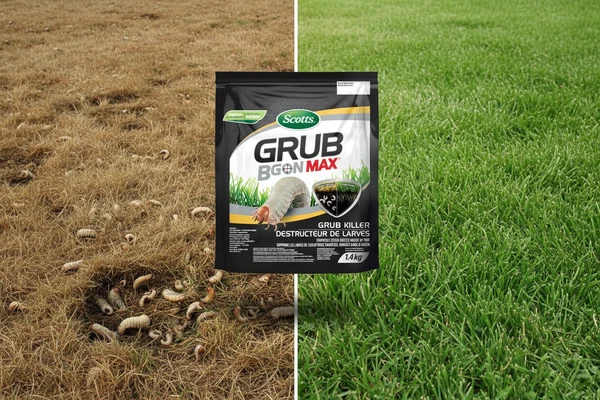
Signs of Grub Damage
Dead patches that first look drought-stressed then go completely brown despite watering. Usually appear in late August–September. Patches expand outward as grubs spread.
The definitive sign — turf in affected areas has no root attachment and peels back with little resistance. Healthy turf resists pulling firmly.
Skunks, raccoons, crows, and starlings dig up grub-infested turf. If you're finding holes and torn turf in the morning, a grub infestation is almost certain.
After peeling back turf, C-shaped white grubs are visible in the top 4–6 inches of soil. Brown head capsule, three pairs of legs near the head.
Canada — Product Availability & Timing
Most chemical grub control products are available across Canadian provinces, though specific formulations vary. Ontario and Quebec homeowners should note that while the cosmetic pesticide ban restricts broadleaf herbicides, it does not prohibit insecticides used to control damaging lawn pests like grubs — check with your local garden centre for currently approved products.
Beneficial nematodes and milky spore are fully permitted in all provinces including Ontario and Quebec. Nematodes are widely available at Canadian Tire, Home Hardware, and most garden centres from late July through September. Apply in the evening after watering, keep soil moist for 2 weeks after application. For prairie provinces, treat by mid-September as the window closes quickly with cooling soil temperatures.
If it's May–July: Scotts GrubEx1 (chlorantraniliprole) is the best preventive — 92% control, lowest toxicity, 4-month residual. If it's August–September with visible damage: Dylox (trichlorfon) is the only effective curative option. Never apply a preventive product on an existing late-summer infestation. Always water in within 24 hours.