In This Guide
- What Is Crabgrass and Why Is It So Hard to Kill?
- Pre-Emergent vs Post-Emergent: Which Do You Need?
- Quick Comparison: Best Crabgrass Killers
- Top 5 Crabgrass Killers Reviewed
- Seasonal Timing Guide: When to Apply
- Grass Safety: Which Products Are Safe for Your Lawn
- How to Apply a Crabgrass Killer Step by Step
- Crabgrass vs Other Lawn Weeds
- Frequently Asked Questions
What Is Crabgrass and Why Is It So Hard to Kill?
Crabgrass (Digitaria spp.) is a warm-season annual grass that germinates from seed each spring, grows aggressively through summer, produces thousands of seeds by fall, and then dies with the first frost. The seeds it drops remain viable in the soil for up to three years -- which is why crabgrass comes back every summer even after you kill the visible plants.
It is one of the most competitive lawn weeds in North America. A single crabgrass plant can produce up to 150,000 seeds in a single season. It thrives in the same heat and drought conditions that stress your lawn, spreading into thin or bare patches faster than desirable grass can recover.
The reason most homeowners struggle with crabgrass is that they treat it at the wrong time. Crabgrass is almost impossible to kill before it matures and sets seed in mid-summer. The most effective strategy is prevention through pre-emergent herbicides applied before germination in spring.
Crabgrass grows in a star or crab-like pattern low to the ground, with wide, flat leaf blades that are lighter green than your lawn. It spreads outward from a central point and lacks the upright growth habit of most lawn grasses. By late summer it develops distinctive finger-like seed heads that radiate from the stem tip.
Pre-Emergent vs Post-Emergent: Which Do You Need?
The answer depends entirely on the time of year and whether crabgrass has already germinated in your lawn.
Pre-Emergent Crabgrass Control
A pre-emergent herbicide creates a chemical barrier in the top layer of soil that prevents crabgrass seeds from germinating. It does not kill existing plants and has no effect once crabgrass has already sprouted. The application window is narrow -- you must apply before soil temperatures at 2 to 3 inches depth reach 55°F consistently.
Pre-emergent is always the preferred approach because it prevents the problem entirely. Products like pendimethalin (Scotts Halts) and dithiopyr (Dimension) are the most widely available for residential use.
Post-Emergent Crabgrass Control
If crabgrass is already visible and growing in your lawn, you need a post-emergent herbicide. These are selective products that target crabgrass while leaving established lawn grasses unharmed -- but only if you choose the right product for your grass type.
Post-emergent crabgrass killers work best on young plants with 2 to 4 leaf blades. Once crabgrass is mature and actively setting seed (mid-summer), post-emergents become much less effective. At that stage, the most practical approach is to apply post-emergent to prevent seed spread and plan for a solid pre-emergent application the following spring.
Pre-emergent herbicides prevent all seeds from germinating -- not just crabgrass. If you plan to overseed bare patches or a thin lawn this fall, do not apply a pre-emergent in the same season. Wait until the new grass is established through at least two or three mowing cycles before resuming pre-emergent applications the following spring.
Quick Comparison: Best Crabgrass Killers (2026)
| # | Product | Active Ingredient | Type | Best For | Grass Safe? |
|---|---|---|---|---|---|
| 1 | Tenacity Turf Herbicide | Mesotrione 4% | Pre + Post | Cool-season lawns, best overall | Cool-Season |
| 2 | Scotts Halts Crabgrass Preventer | Pendimethalin 1.71% | Pre-Emergent | Spring prevention, most lawns | Most Types |
| 3 | Drive XLR8 Herbicide | Quinclorac 18.92% | Post-Emergent | Warm-season & cool-season | Most Types |
| 4 | Ortho Weed B Gon Crabgrass Killer | Quinclorac + MCPA | Post-Emergent | Spot treatment, ready-to-use | Most Types |
| 5 | Scotts Turf Builder with Halts | Pendimethalin 0.86% | Pre-Emergent | Spring feed + prevention combo | Check Label |
Top 5 Crabgrass Killers Reviewed
Tenacity is the standout crabgrass killer for cool-season lawns. Mesotrione inhibits photosynthesis in target weeds -- crabgrass turns white and dies within 2 to 3 weeks of application. What makes Tenacity exceptional is that it works both as a pre-emergent (when applied before germination) and a post-emergent (when applied to established crabgrass up to the 3-tiller stage).
The concentrate is highly economical. A 8 fl oz bottle treats up to 1 acre. For best post-emergent results, apply in two treatments 2 to 3 weeks apart. Add a non-ionic surfactant to the tank mix to improve leaf coverage and uptake.
The important limitation: Tenacity is labeled for cool-season grasses only. It should not be applied to Bermuda grass, St. Augustine, or Zoysia. Always confirm your grass species before using this product.
Pros
- Pre- and post-emergent in one product
- Kills crabgrass without harming cool-season grasses
- Highly economical -- small amount per application
- Also controls nutsedge and many broadleaf weeds
- Visible results within 7 to 14 days
Cons
- Not safe for warm-season grasses (Bermuda, Zoysia, St. Augustine)
- Requires a surfactant for post-emergent use
- Two applications often needed for mature crabgrass
- Can temporarily whiten non-target grasses
Scotts Halts is the most widely available residential crabgrass preventer in North America. The granular format is simple to apply with a standard spreader and requires watering in after application to activate the soil barrier.
Pendimethalin binds tightly to soil particles and prevents crabgrass seeds from sending down roots after germination. It has no post-emergent activity -- once crabgrass has sprouted, this product will not help. Timing is everything with Scotts Halts. Apply it when soil temperatures at 2 to 3 inches depth reach 50°F, approximately 2 weeks before the forsythia in your area finishes blooming.
The product is safe for most established lawn grasses including Kentucky bluegrass, tall fescue, perennial ryegrass, Bermuda, and Zoysia. It is not safe for bentgrass or certain warm-season varieties -- check the label before applying.
Pros
- Available at Home Depot, Lowes, and most hardware stores
- Easy granular application with any broadcast spreader
- Safe for most established lawn grass types
- Long residual control -- up to 4 months
- Proven formula used by homeowners for decades
Cons
- Pre-emergent only -- no effect on established crabgrass
- Cannot overseed for 4 months after application
- Must be watered in within 14 days of application
- Narrow timing window -- easy to apply too late
Drive XLR8 is the most broadly labeled post-emergent crabgrass killer available to residential users. Quinclorac is effective on crabgrass at all growth stages -- from seedling to late tillering -- making it the best option when crabgrass is already well established in your lawn.
The product is safe for Kentucky bluegrass, tall fescue, perennial ryegrass, Bermuda grass, and Zoysia -- covering both warm-season and cool-season applications. This makes it the go-to post-emergent for homeowners who are unsure of their grass type or have a mixed-species lawn.
For best results, apply Drive XLR8 when crabgrass is actively growing and the temperature is above 60°F. Add methylated seed oil (MSO) to the tank for improved efficacy on waxy-leafed plants. Two applications 2 to 3 weeks apart are recommended for mature crabgrass.
Pros
- Works on warm-season and cool-season lawns
- Effective on mature crabgrass, not just seedlings
- Also controls clover, chickweed, and some sedge
- Liquid concentrate -- easy to measure and mix
Cons
- Requires MSO surfactant for best results
- Not labeled for St. Augustine or centipede grass
- Two treatments often needed for heavy infestations
- Results take 7 to 21 days to fully develop
Ortho Weed B Gon Crabgrass Killer is the most accessible post-emergent option for homeowners who want a simple, reliable spot treatment. The addition of MCPA gives it broadleaf activity beyond just crabgrass, also targeting dandelions, clover, and other common lawn weeds in a single application.
The concentrate version connects directly to a garden hose, making application straightforward without the need for a sprayer. It is a practical choice for smaller lawns or targeted spot treatment in areas where crabgrass is localized rather than spread across the whole lawn.
Pros
- Also kills dandelions, clover, and broadleaf weeds
- Hose-end connector for easy application
- Widely available at Home Depot and Lowes
- No tank sprayer required
Cons
- Less effective on mature crabgrass than Drive XLR8
- Not safe for St. Augustine, Bermuda in some formulations
- Hose-end application is less precise than a sprayer
This combination product lets you fertilize your lawn and apply a crabgrass preventer in a single pass with a broadcast spreader. The spring timing for pre-emergent application aligns well with the first fertilizer application of the season, making this a practical time-saver for most homeowners.
The pendimethalin concentration is slightly lower than in Scotts Halts Alone, so for high-pressure crabgrass situations or lawns with a history of heavy infestation, using Scotts Halts independently will give slightly stronger barrier protection. This product works best as a maintenance tool in years following a successful kill-off.
Pros
- Fertilizes and prevents crabgrass in one application
- Ideal spring routine for low-to-moderate crabgrass pressure
- Simple spreader application
- Widely available at major retailers
Cons
- Lower pendimethalin concentration than Halts standalone
- Cannot overseed for several months after application
- Not ideal for severe crabgrass infestations
Seasonal Timing Guide: When to Apply Crabgrass Control
Timing your application to the soil temperature -- not the calendar date -- is the single most important factor in crabgrass control. Soil temperatures vary significantly by region and year. The dates below are averages. Use a soil thermometer for precise readings.
The Forsythia Timing Trick
The most reliable visual cue for pre-emergent application is forsythia bloom. When forsythia shrubs in your area are just beginning to lose their yellow flowers, soil temperatures are typically approaching 55°F. Apply your pre-emergent at this moment for peak timing. This works across all regions and removes the need for a soil thermometer for most homeowners.
What If You Miss the Pre-Emergent Window?
If you missed the window and crabgrass is already visible in your lawn, switch immediately to a post-emergent product. Tenacity or Drive XLR8 applied to young crabgrass (2 to 4 leaf blades) is highly effective. Apply at 2 to 3 week intervals if needed, then commit to a pre-emergent application the following spring to break the cycle.
In regions with long, hot summers -- the Deep South, California, Texas -- a second pre-emergent application in early summer extends the soil barrier through August when late-germinating crabgrass would otherwise break through. Use split-rate applications rather than doubling the single-application rate.
Grass Safety: Which Crabgrass Killer Is Safe for Your Lawn
Using the wrong crabgrass killer on the wrong grass type can thin or kill your lawn. This table summarizes the safety profile of each product reviewed above for the most common US and Canadian lawn grass types.
| Grass Type | Tenacity | Scotts Halts | Drive XLR8 | Ortho Weed B Gon | Turf Builder Halts |
|---|---|---|---|---|---|
| Kentucky Bluegrass | Safe | Safe | Safe | Safe | Safe |
| Tall Fescue | Safe | Safe | Safe | Safe | Safe |
| Perennial Ryegrass | Safe | Safe | Safe | Safe | Safe |
| Bermuda Grass | Not Safe | Safe | Safe | Check Label | Check Label |
| St. Augustine | Not Safe | Safe | Not Labeled | Not Labeled | Check Label |
| Zoysia | Not Safe | Safe | Safe | Check Label | Check Label |
| Centipede Grass | Not Safe | Check Label | Not Labeled | Not Labeled | Not Safe |
Always read and follow the full product label before application. Formulations change. "Check Label" means the product may be safe at reduced rates or under specific conditions -- verify before applying.
How to Apply a Crabgrass Killer Step by Step
Pre-Emergent Application (Granule)
- 1Check soil temperature
Measure soil temperature at 2 to 3 inches depth. Apply when readings reach 50°F consistently for at least three consecutive days, before they hit 55°F. Alternatively, apply at forsythia bloom in your area.
- 2Mow and clear debris
Mow the lawn at your normal height and remove any heavy leaf or thatch buildup that could intercept the granules before they reach the soil surface.
- 3Set spreader to the label rate
Use the spreader setting listed on the product label. Apply in two half-rate passes at perpendicular angles for even coverage. Overlap slightly at each pass to avoid skipped strips.
- 4Water in within 14 days
Granular pre-emergents must be watered into the soil to activate. Apply at least 0.25 to 0.5 inches of water within 14 days of spreading. Do not water heavily enough to wash product off the lawn.
Post-Emergent Application (Liquid)
- 1Apply when crabgrass is young and actively growing
Target crabgrass with 2 to 4 leaf blades (young plants). Apply when air temperatures are between 60°F and 90°F and no rain is forecast for 24 hours after treatment.
- 2Mix to the label rate and add surfactant
For liquid concentrates like Tenacity or Drive XLR8, measure carefully to the label rate. Add a non-ionic surfactant or methylated seed oil (MSO) at the recommended rate to improve leaf adhesion and uptake.
- 3Spray to thorough coverage, not run-off
Apply until the crabgrass leaves are fully coated but not dripping. Over-application wastes product and increases risk of lawn damage. Use a fan tip nozzle for even coverage on broadcast applications.
- 4Repeat in 2 to 3 weeks if needed
A second application 14 to 21 days after the first is often necessary for mature crabgrass or heavy infestations. Do not exceed the maximum annual application rate listed on the product label.
Crabgrass vs Other Common Lawn Weeds
Crabgrass is often confused with other grassy weeds, and many lawns deal with multiple weed types at once. Here is how crabgrass control compares to treatment for other common lawn weed problems.
Dandelions
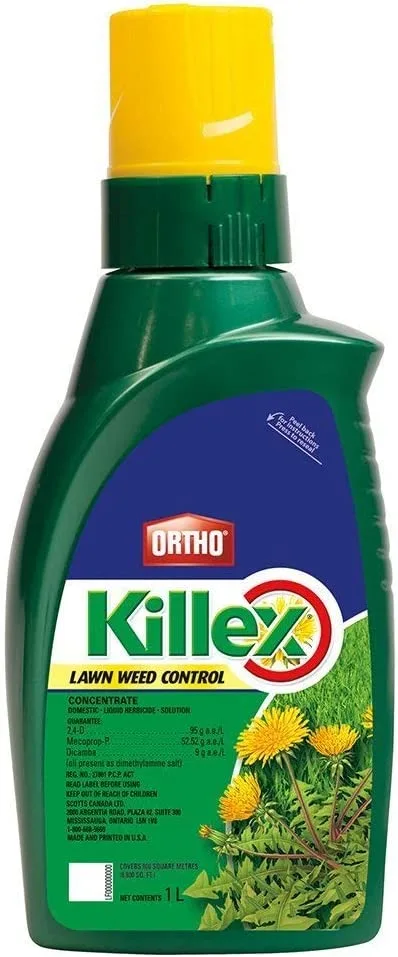
Dandelions are broadleaf weeds and require different chemistry than crabgrass. Selective broadleaf herbicides (2,4-D, MCPA) kill dandelions safely on most lawns. Pre-emergent products that target crabgrass have no effect on dandelion seeds.
See Dandelion Killer Guide →Nutsedge
Nutsedge is a sedge -- not a true grass or broadleaf weed -- and standard crabgrass killers will not control it. Halosulfuron (Sedgehammer) or sulfentrazone (Ortho Nutsedge Killer) are the right products for yellow and purple nutsedge.
See Nutsedge Killer Guide →Clover in Lawn
White clover is a broadleaf weed -- crabgrass pre-emergents have no effect on it. Triclopyr or a three-way herbicide mix (2,4-D + MCPA + dicamba) kills clover without harming grass.
How to Kill Clover →Thorny Lawn Weeds
Thistle, bramble, and other thorny weeds need targeted broadleaf or non-selective control depending on where they are growing. Crabgrass products will not affect them.
ID & Control Guide →Crabgrass that grows through cracks in driveways, patios, or walkways is not a lawn problem -- it requires a non-selective herbicide. Glyphosate or a non-selective contact killer works well on driveway crabgrass where there is no concern about nearby lawn damage. See our weed killer for driveways guide for the best options.
Frequently Asked Questions
Tenacity (mesotrione) is the best crabgrass killer for cool-season grasses because it works as both a pre-emergent and post-emergent. For warm-season lawns, Drive XLR8 (quinclorac) is the safest and most effective post-emergent option. For spring prevention before crabgrass germinates, Scotts Halts Crabgrass Preventer is the most widely available and reliable choice.
Apply a crabgrass pre-emergent when soil temperatures reach 50 to 55°F at 2 to 3 inches depth. This typically occurs in early spring -- March in the South, April in the Midwest, and late April to early May in Canada and the northern US. The most reliable timing cue is when forsythia shrubs in your area begin to lose their yellow flowers.
Yes. Selective herbicides including mesotrione (Tenacity) and quinclorac (Drive XLR8) kill crabgrass without harming most established lawn grasses when used at label rates. Tenacity is safe for Kentucky bluegrass, tall fescue, and perennial ryegrass. Drive XLR8 is safe for Bermuda, St. Augustine (check label), and Zoysia. Always confirm your grass type before applying any herbicide.
Killing existing crabgrass does not prevent new seeds from germinating the following spring. Crabgrass seeds remain viable in the soil for up to three years. To stop the cycle, apply a pre-emergent herbicide every spring before soil temperatures warm to 55°F. Maintaining a thick, dense lawn also helps crowd out crabgrass seedlings before they can establish.
Selective herbicides including mesotrione (Tenacity) and quinclorac (Drive XLR8) are labeled to kill crabgrass without harming most lawn grasses. Pre-emergent products like pendimethalin (Scotts Halts) prevent crabgrass germination without affecting established grass. Never use glyphosate or any non-selective herbicide on your lawn -- these will kill all vegetation including the desired grass.
The most effective crabgrass control strategy is consistent spring pre-emergent application timed to forsythia bloom. If crabgrass is already growing, use Tenacity for cool-season lawns or Drive XLR8 for warm-season lawns. Kill it early, apply pre-emergent next spring, and maintain a thick lawn to deny crabgrass the bare patches it needs to establish.
More Lawn Weed Guides
Best Dandelion Killer
Top broadleaf herbicides for killing dandelions in lawns and garden beds without harming grass.
Read Guide → Weed Control GuideHow to Kill Clover in Your Lawn
Selective herbicides, organic options, and timing tips to eliminate white and red clover from established lawns.
Read Guide → Product GuideBest Nutsedge Killer
Nutsedge is not a grass and needs different chemistry. Sedgehammer, Tenacity, and other top options compared.
Read Guide → Identification GuideCommon Lawn Weeds with Thorns
Identify thistle, bramble, and other thorny lawn weeds with control methods for each weed type.
Read Guide →