In This Guide
- Why Clover Grows in Your Lawn
- White Clover vs Red Clover: What You Have
- Quick Comparison: Best Clover Killers
- Top 5 Products to Kill Clover Reviewed
- Best Time to Kill Clover in Your Lawn
- How to Apply Clover Killer Step by Step
- How to Prevent Clover from Coming Back
- Clover vs Other Common Lawn Weeds
- Frequently Asked Questions
Why Clover Grows in Your Lawn
Clover does not show up randomly. Its presence is almost always a symptom of an underlying lawn problem -- most commonly low nitrogen levels in the soil. Clover is a legume that fixes its own nitrogen from the air, which means it can thrive in nutrient-poor soil where grass struggles to compete.
If clover is spreading in your lawn, it is telling you one of three things: your soil is low in nitrogen, your lawn is too thin and sparse to crowd it out, or both. Killing the visible clover without addressing these conditions means it will return within a season or two.
Common causes of clover invasion include inconsistent or insufficient fertilizing, soil compaction that limits grass root growth, low mowing height that opens the turf canopy, and bare patches left from drought, disease, or foot traffic.
Clover is easy to spot: look for trifoliate leaves (three rounded leaflets per stem) growing low to the ground. White clover produces small white ball-shaped flowers and spreads by runners (stolons) that root along the ground. Red clover grows taller and more upright with pink-red flowers. Both are broadleaf weeds that respond to the same herbicide chemistry.
White Clover vs Red Clover: What You Have
Knowing which type of clover is in your lawn helps you choose the right approach. Both respond to broadleaf herbicides, but they differ in growth habit and how aggressively they spread.
| Type | Flower Color | Growth Habit | Spread | Common In |
|---|---|---|---|---|
| White Clover (Trifolium repens) | White, ball-shaped | Low, creeping stolons | Aggressive, forms dense mats | Most US and Canadian lawns |
| Red Clover (Trifolium pratense) | Pink-red, oval | Upright, clumping | Seeds only, less aggressive | Fields, roadsides, lawn edges |
| Strawberry Clover (Trifolium fragiferum) | Pink-white, round | Low, creeping | Runners and seeds | Moist, poorly drained soils |
White clover is by far the most common lawn problem in North America. Its spreading stolons allow it to quickly colonize thin or bare areas. Red clover is more often seen at lawn edges and does not spread as aggressively into dense turf.
Quick Comparison: Best Products to Kill Clover in Lawn (2026)
| # | Product | Active Ingredient | Clover Kill | Grass Safe? | Best For |
|---|---|---|---|---|---|
| 1 | Ortho Weed B Gon Chickweed, Clover & Oxalis Killer | Triclopyr 8% | Excellent | Most types | Best dedicated clover killer |
| 2 | Speedzone Broadleaf Herbicide | 2,4-D + Triclopyr + Dicamba + Carfentrazone | Excellent | Cool-season | Fastest results, mixed weed lawns |
| 3 | Scotts Turf Builder Triple Action | Quinclorac + MCPA + Mecoprop | Good | Most types | Feed + kill combo, spring application |
| 4 | Southern Ag Lawn Weed Killer (2,4-D) | 2,4-D Amine 46.5% | Moderate | Most types | Large area, economical broadleaf control |
| 5 | Natural Armor Weed Killer | Clove oil + citric acid | Contact only | Non-selective | Organic spot treatment, hardscape edges |
Top 5 Products to Kill Clover in Your Lawn
Triclopyr is the most effective single active ingredient for killing clover in an established lawn. It targets the xylem tissue in broadleaf plants, causing rapid cell death while leaving lawn grasses unharmed. This Ortho formulation is one of the few products specifically labeled for clover, chickweed, and oxalis -- the three most common low-growing broadleaf lawn weeds.
The concentrate is economical and covers a large area. Mix with water and apply with a pump or backpack sprayer. For best results on white clover, apply when plants are actively growing and temperatures are between 60 and 85°F. Results appear within 7 to 14 days.
Triclopyr is safe for Kentucky bluegrass, tall fescue, perennial ryegrass, and most warm-season grasses. It should not be applied to St. Augustine or bentgrass. Always confirm your grass species against the product label.
Pros
- Specifically formulated for clover, chickweed, and oxalis
- Highly effective on mature white clover mats
- Safe for most cool and warm-season grasses
- Economical concentrate -- covers large areas
- Visible results within 7 to 14 days
Cons
- Not safe for St. Augustine or bentgrass
- Requires pump sprayer for application
- Second application may be needed for heavy mats
Speedzone is the fastest-acting broadleaf herbicide available to residential users. The carfentrazone component causes rapid cell damage and visible wilting within hours of application -- even on mature, established clover. The remaining three active ingredients (2,4-D, triclopyr, and dicamba) provide systemic control that kills the plant root and all.
This is the best choice when your lawn has a mixed weed problem -- clover alongside dandelions, plantain, ground ivy, or other broadleaf weeds. One application addresses all of them simultaneously. It is labeled for cool-season grasses including Kentucky bluegrass, tall fescue, and perennial ryegrass.
Pros
- Visible results within hours, not days
- Four active ingredients cover a wide range of broadleaf weeds
- Kills clover, dandelions, and ground ivy in one application
- Economical for large lawn coverage
Cons
- Not safe for warm-season grasses (Bermuda, Zoysia, St. Augustine)
- Do not apply in extreme heat above 90°F
- Requires careful mixing -- concentrated formula
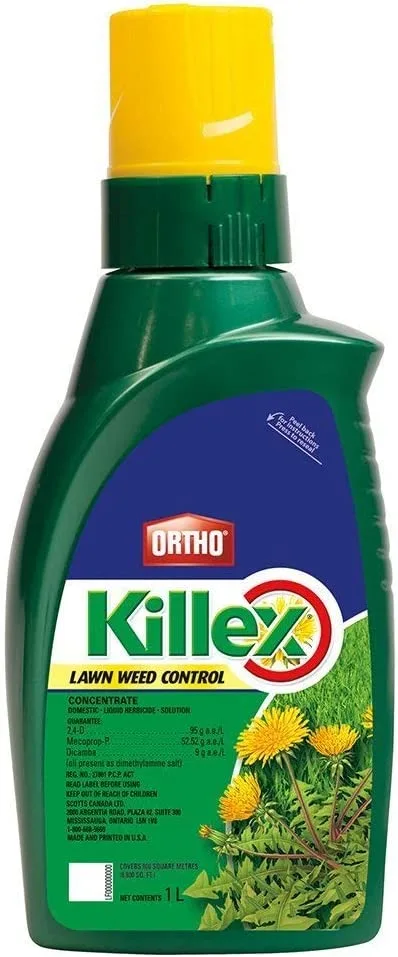
Scotts Triple Action feeds your lawn, prevents crabgrass, and kills broadleaf weeds including clover in a single spreader pass. The granular MCPA and mecoprop combination controls clover effectively, though it works more slowly than liquid triclopyr. Results typically appear within 2 to 4 weeks.
This is the most practical choice for homeowners who want to handle clover control alongside their regular spring lawn feeding routine. It is particularly well suited to lawns with light-to-moderate clover coverage where the goal is maintenance rather than emergency control.
Pros
- Feeds lawn, prevents crabgrass, and kills clover in one step
- Simple granular spreader application
- Safe for most established grass types
- Widely available at Home Depot and Lowes
Cons
- Slower results than liquid herbicides
- Less effective on heavy, mature clover mats
- Cannot overseed for several months after use
2,4-D is the most widely used broadleaf herbicide in the world and has decades of proven performance on clover. Southern Ag's amine formulation is one of the most economical broadleaf herbicide concentrates available -- a single quart treats up to 2 acres.
2,4-D alone is somewhat less effective on clover than triclopyr, which is why combining it with a triclopyr or dicamba product in a tank mix can significantly improve results on stubborn clover. Used alone, it works best on young, actively growing clover in spring or fall.
Pros
- Extremely economical for large lawns
- Proven decades-long track record on broadleaf weeds
- Safe for most established cool and warm-season grasses
- Effective tank mix partner with triclopyr or dicamba
Cons
- Less effective on clover alone than triclopyr
- Slower results -- 14 to 21 days
- Volatile in high heat -- do not apply above 85°F
Natural Armor is an OMRI-listed organic herbicide that uses clove oil and citric acid to burn and desiccate plant tissue on contact. It works quickly -- within hours -- and leaves no synthetic chemical residue. However, it is non-selective, meaning it will kill grass as readily as clover.
Its best use case for lawns is spot-treating clover in driveways, path edges, or garden borders where there is no lawn grass to protect. It also does not kill roots, meaning established clover will likely regrow from the crown after a few weeks. Multiple applications are typically needed.
Pros
- OMRI listed -- safe for organic programs
- Fast contact action, visible results within hours
- No synthetic residue in soil
- Safe around pets and children once dry
Cons
- Non-selective -- kills grass as well as clover
- Contact only -- does not kill roots, clover regrows
- Multiple applications required for persistent clover
- Not practical for large lawn applications
Best Time to Kill Clover in Your Lawn
Timing your application correctly is the second most important factor after product selection. Clover is a perennial that can be treated throughout the growing season, but spring and early fall produce the best results.
Spring Application
Spring is the prime window for killing clover. Plants are actively growing, the root system is fully engaged, and cool temperatures reduce the risk of herbicide volatilization or turf stress. Apply after the lawn has been mowed at least twice for the season and temperatures are consistently above 50°F.
Early Fall Application
Early fall is equally effective and often produces cleaner results. Clover plants are translocating nutrients back to the roots for winter storage, which means they also translocate systemic herbicides more efficiently. Fall applications kill both the above-ground growth and the root system, reducing regrowth the following spring.
Summer Application
Summer application is possible but requires caution. Apply early in the morning before temperatures exceed 85°F. Avoid midsummer application during drought stress or heat waves, as stressed turf is more susceptible to herbicide injury. 2,4-D is particularly volatile in high heat and should be avoided when temperatures exceed 85°F.
Herbicides need 24 to 48 hours of dry weather after application to be absorbed through leaf tissue. Rain within this window washes the product off before it can work. Check the forecast before applying and avoid application if rain is expected within 24 hours.
How to Apply Clover Killer Step by Step
- 1Mow 2 to 3 days before application
Mow the lawn 2 to 3 days before treating. This stimulates new leaf growth with greater surface area for herbicide absorption. Do not mow immediately before application -- freshly cut leaves have reduced surface area and fewer open stomata for uptake.
- 2Mix herbicide to the label rate -- do not exceed it
Measure concentrate carefully using a graduated cylinder. Higher rates do not improve clover kill and increase the risk of turf damage. Add a non-ionic surfactant at the label-recommended rate to improve adhesion on the waxy clover leaf surface.
- 3Apply in calm conditions between 60 and 85°F
Spray in the early morning when temperatures are within range and wind is below 10 mph. Wind drift can carry herbicide onto ornamental plants, vegetables, and garden beds. Use a fan-tip nozzle for even coverage over large areas and a cone nozzle for precise spot treatment.
- 4Do not mow for 2 to 3 days after application
Let the herbicide move through the plant systemically before cutting. Mowing too soon removes treated leaf tissue before the active ingredient can reach the roots. Wait until you see clear signs of wilt or chlorosis before mowing.
- 5Repeat in 3 to 4 weeks if needed
Dense, mature clover mats often require a second application 3 to 4 weeks after the first. The initial treatment weakens the plant and opens gaps in the canopy -- the second application finishes off any surviving clover before it can recover. Do not exceed the maximum annual application rate on the product label.
How to Prevent Clover from Coming Back
Killing clover without addressing the conditions that allowed it to establish means it will return within a season. The two most effective long-term prevention strategies are nitrogen fertilization and overseeding.
Fertilize with Nitrogen
Clover cannot compete with dense, well-fed turf. It establishes precisely because it can fix nitrogen in nitrogen-deficient lawns. After treating clover, apply a nitrogen-rich fertilizer (look for a product with a high first number in the N-P-K ratio, such as 32-0-10 or 24-0-11) to raise soil nitrogen levels and give the grass a competitive advantage. See our summer fertilizer guide for product recommendations.
Overseed Bare Patches
Clover takes hold fastest in thin areas and bare patches. After killing clover, overseed any bare spots with an appropriate grass seed for your region. Dense turf physically prevents clover seedlings from establishing. Fall overseeding is especially effective since soil temperatures are warm enough for germination but cool enough to favor grass over weeds.
Raise Your Mowing Height
Mowing too short weakens grass and opens the turf canopy to weed invasion. Raising your mowing height by 0.5 to 1 inch shades the soil surface, reducing the light that clover seedlings need to germinate. Set cool-season grasses to 3 to 4 inches in summer. Set Bermuda and Zoysia to 2 to 2.5 inches.
Clover seeds remain viable in soil for several years. An annual broadleaf herbicide application in early fall -- even in years when clover is not yet visible -- prevents seeds that germinated during summer from establishing roots and overwintering. A light preventive application is far more effective than waiting for a full infestation to develop.
Clover vs Other Common Lawn Weeds
Clover control is straightforward once you have the right product. But if your lawn has multiple weed problems, different weeds often require different herbicide chemistry. Here is how clover compares to other top lawn weed problems.
Crabgrass
Crabgrass is a grassy weed -- not a broadleaf. Clover herbicides (triclopyr, 2,4-D) have no effect on it. Crabgrass requires selective grassy-weed herbicides like quinclorac or mesotrione, or a pre-emergent applied in spring.
Crabgrass Killer Guide →Dandelions
Dandelions respond to the same broadleaf chemistry as clover. A three-way herbicide mix (2,4-D + triclopyr + dicamba) kills both clover and dandelions simultaneously, making it efficient when both are present.
Dandelion Killer Guide →Nutsedge
Nutsedge looks like a grass and is often mistaken for a clover-related problem in wet lawns. It is a sedge and requires completely different chemistry -- halosulfuron (Sedgehammer) or sulfentrazone. Broadleaf herbicides will not control it.
Nutsedge Killer Guide →Clover growing through driveway cracks or in gravel paths does not need a selective herbicide. A non-selective product like glyphosate or a natural clove-oil spray will work. For long-term control on hardscape, use a product with soil sterilant residual activity. See our weed killer for driveways guide for the best options.
Frequently Asked Questions
Selective broadleaf herbicides including triclopyr, 2,4-D, and MCPA kill clover without harming most established lawn grasses. Triclopyr is the most effective single ingredient for clover. Three-way mixes combining 2,4-D, MCPA, and dicamba work well on mixed broadleaf weed problems. Always confirm the product is labeled as safe for your specific grass type before applying.
Clover returns because its seeds remain viable in soil for several years, and it thrives in nitrogen-deficient lawns. After killing clover, fertilize your lawn with a nitrogen-rich product to crowd out any regrowth. Overseed bare patches left behind. Annual preventive herbicide applications in early fall significantly reduce repeat infestations over time.
Spring and early fall are the best times to kill clover in a lawn. Apply when clover is actively growing, temperatures are between 60 and 85°F, and no rain is forecast for 24 hours. Early fall applications are especially effective because clover is actively translocating nutrients to its roots, which also carries systemic herbicides deeper into the plant for a more complete kill.
No. Vinegar (acetic acid) is a non-selective contact herbicide that will kill or damage any plant it touches, including your lawn grass. It can be used on clover in driveways, patios, or garden paths where there is no surrounding grass to protect, but it is not safe for use on an established lawn.
After killing clover, apply a nitrogen fertilizer to raise soil nitrogen -- clover cannot compete with dense, well-fed turf. Overseed bare patches to restore thick grass coverage. Raise your mowing height to shade the soil and prevent clover seedling germination. An annual early fall broadleaf herbicide application stops new seedlings from establishing before they can overwinter.
The most effective clover control strategy is a two-step approach: apply a triclopyr-based selective herbicide in spring or early fall, then follow up with nitrogen fertilizer and overseeding to restore the thick turf that prevents clover from returning. Killing clover without fixing the lawn conditions that invited it is only a temporary fix.
More Lawn Weed Guides
How to Kill Crabgrass
Pre-emergent and post-emergent crabgrass control with seasonal timing guide and grass-safe product reviews.
Read Guide → Product GuideBest Dandelion Killer
Top broadleaf herbicides for killing dandelions in lawns without harming grass. Products reviewed for 2026.
Read Guide → Product GuideBest Nutsedge Killer
Nutsedge is not a broadleaf weed and needs different chemistry. Sedgehammer and other top options compared.
Read Guide → Product GuideBest Weed Killer for Driveways
Non-selective and residual weed killers for driveways, patios, and pavement cracks including clover and grass.
Read Guide →